Wednesday, October 10, 2018

Continuation

It goes on here...https://paintingsunderglass.tumblr.com/

Friday, July 25, 2014

Elstir's Harbor at Carquethuit


    "...the eclipses of perspective."

On the beach in the foreground the painter had contrived that the eye should discover no fixed boundary, no absolute line of demarcation between land and sea. The men who were pushing down their boats into the sea were running as much through the waves as along the sand, which, being wet, reflected the hulls as if they were already in the water. The sea itself did not come up in an even line but followed the irregularities of the shore, which the perspective of the picture increased still further, so that a ship actually at sea, half-hidden by the projecting works of the arsenal, seemed to be sailing through the middle of the town; women gathering shrimps among the rocks had the appearance, because they were surrounded by water and because of the depression which, beyond the circular barrier of rocks, brought the beach (on the two sides nearest the land) down to sea-level, of being in a marine grotto overhung by ships and waves, open yet protected in the midst of miraculously parted waters. If the whole picture gave this impression of harbours in which the sea penetrated the land, in which the land was subaqueous and the population amphibian, the strength of the marine element was everywhere apparent; and round about the rocks, at the mouth of the harbour where the sea was rough, one sensed, from the muscular efforts of the fishermen and the slant of the boats leaning over at an acute angle, compared with the calm erectness of the warehouse, the church, the houses in the town to which some of the figures were returning and from which others were setting out to fish, that they were riding bareback on the water as though on a swift and fiery animal whose rearing, but for their skill, must have unseated them.

Excerpt From: Marcel Proust, Terence Kilmartin, C.K. Scott Moncrieff, Andreas Mayor & D.J. Enright. “In Search of Lost Time.” The Modern Library.


Monday, April 28, 2014

Resemblance the book is no longer available. My thanks to all who bought it. I hope it has given you pleasure and I hope it will continue to do so.

Making the book was an experience like no other. A great deal of time elapsed between starting to paint the characters of À la recherche du temps perdu and eventually watching others look at them in a finished book, but the span is bridged by all that occurred from start to finish, including personal loss and artistic redemption: the book came from the heart, the mind, and the hand, it was good work to do. For this I thank Marcel Proust.

The experience became elaborate in New York. Missing the curb and the hand of the doorman at an apartment on Central Park West as I got out of a cab and broke my left femur at the knee seems full of hubris, but I will never again enjoy the pleasure I felt, unconcerned with pain for half a block, flying down the side walk three days after the fall, my arms in the air, my book in my lap, as I was pushed, and then released, freed, by a friend who rolled me along in a wheelchair and let go and ran beside me. We were laughing, on our way to a party...


Five months later, after physical therapy and acupuncture and the ice-packs and crutches, and the walker the leg is healed but still cranky, and my cane, left hanging and forgotten on shopping cart handles is repeatedly returned in parking lots outside stores by considerate clerks who call me sir.

I have left the hospitality and comforts of the Casa Eureka and have moved back to Carmel Valley after an absence of forty-two years. The return makes me very happy. It is quite beautiful here. I am very lucky.

The house, 50 yards from the river, is on the border where the coastal fog melts into the warmer open sky of the interior. The river, narrowing where the hills gather is mostly dry stone-bed and leaks along slowly through low pools. Wind blows up and down the stream, cottonwood flowers sail over and around leafed out willow, poplar and blooming Scotch broom, a laurel or two flash silver between
pines, and across the draw, where the pleat of the ravine climbs a rise, a stand of 24 eucalyptus bend to the west inhaling sea air, then let go and bend to the east exhaling the scent of crisp honey.

There are birds, frogs, deer. Two rabbits live in the vegetable garden, old friends live minutes away. Gone eighteen months from Redondo, rested in France, exhilarated by Cabourg, encouraged by New York and Berkeley, I am setting up a studio again, in the place where, as a young man, I first tried to make a home of my own away from my parents.


Sunday, November 3, 2013

Resemblance: The Book is Published

Ordering information can be found here:
http://www.davidwesleyrichardson.com/

It can also be purchased in Los Angeles at

The Los Angeles County Museum of Art Store
http://thelacmastore.org/products/resemblance-by-david-richardson

and in Berkeley at

Mrs Dalloway's Bookstore
 http://www.mrsdalloways.com/events/remembrance-things-proust-100th-anniversary-swanns-way-offsite

Friday, September 20, 2013

Resemblance: The Book

I am very pleased to announce that Resemblance: Portraits of Characters from Marcel Proust's In Search of Lost Time is now being printed at Edition One Books in Berkeley. 

There will soon be 100 numbered copies, hard linen cover with dust jacket, 9.75 x 6.75 inches, 178 pages with 78 full color illustrations. The book was designed by Nina Zurier.

This is the dust jacket proof...


This is the proof of the title page...


 This is the proof of Odette de Crécy''s page...


Limited edition prints of Oriane de Guermantes, Charles Swann, Odette de Crécy, Gilberte Swann, Robert de Saint-Loup, Baron de Charlus and Albertine Simonet will also be available. They are being printed by Nicholas Price at Magnolia Editions on Hahnemuhle smooth rag, paper size 14×11 inches, image size 10×6 inches.

George Kanakos is framing the same seven original paintings.

A website for the book and my artwork is being constructed by Lorene Anderson.

Tuesday, August 20, 2013

Monday, August 27, 2012

Mme de Saint-Euverte's Soirée

Acrylic on panel, unframed 9x12 inches, (22.9x30.5 cm), 2012

Framed, 17.5x14.5 inches, (36.8x44.5 cm)

Charles Swann is on the left, Mmes de Cambremer, de Francquetot and de Gallardon are at center. Oriane de Guermantes in her Princesse des Laumes incarnation is at the right.
The painting will be exhibited in a show curated by Sarah Archer at Viktor Wynd Fine Arts in London. It opens October 12 at a celebration of Suzette Field's "A Curious Invitation - The 40 Greatest Parties in Literature", published by Picador.

Thursday, August 4, 2011

Three Orianes

James Everett of Proust Reader wrote in an email conversation that time creates new versions of the characters of In Search for Lost Time and led me to this question:

Supposing the duchess of Guermantes could be reduced in the manner of classical painting to The Three Ages of Man, might the first age be she at the wedding of Dr. Percepied's daughter where young Marcel spies her with a pimple on her nose in Gilbert the Bad's Chapel and a wash of red light from the window depicting her ancestor Geneviève de Brabant fills the church, might the second age show her later, flashing her dazzling smile to Marcel at the opera at the height of her power, and might the third show her near the end of the trail at the matinée Guermantes where she surprises Marcel by exclaiming it wonderful to see "her oldest friend"?

A similar format could be given to all the major characters of course, most of the minor as well. Where and how does Proust show us changes in character, how does he lead the us through lives that are physically and emotionally redefined by incident, experience and time? At what point for instance does Charles Morel change his evil way to those of a family man, when does Miss Sacripant become Mme Swann and Mme Swann Mme de Forcheville, what changes come over Saint-Loup's face between his table jumping at Doncieres, his coming out at the brothels and his hero's death in the trenches? And could we look each in the face and tell them, "Oh, I know who you are" at each point along the path?

Here is Oriane at the wedding...
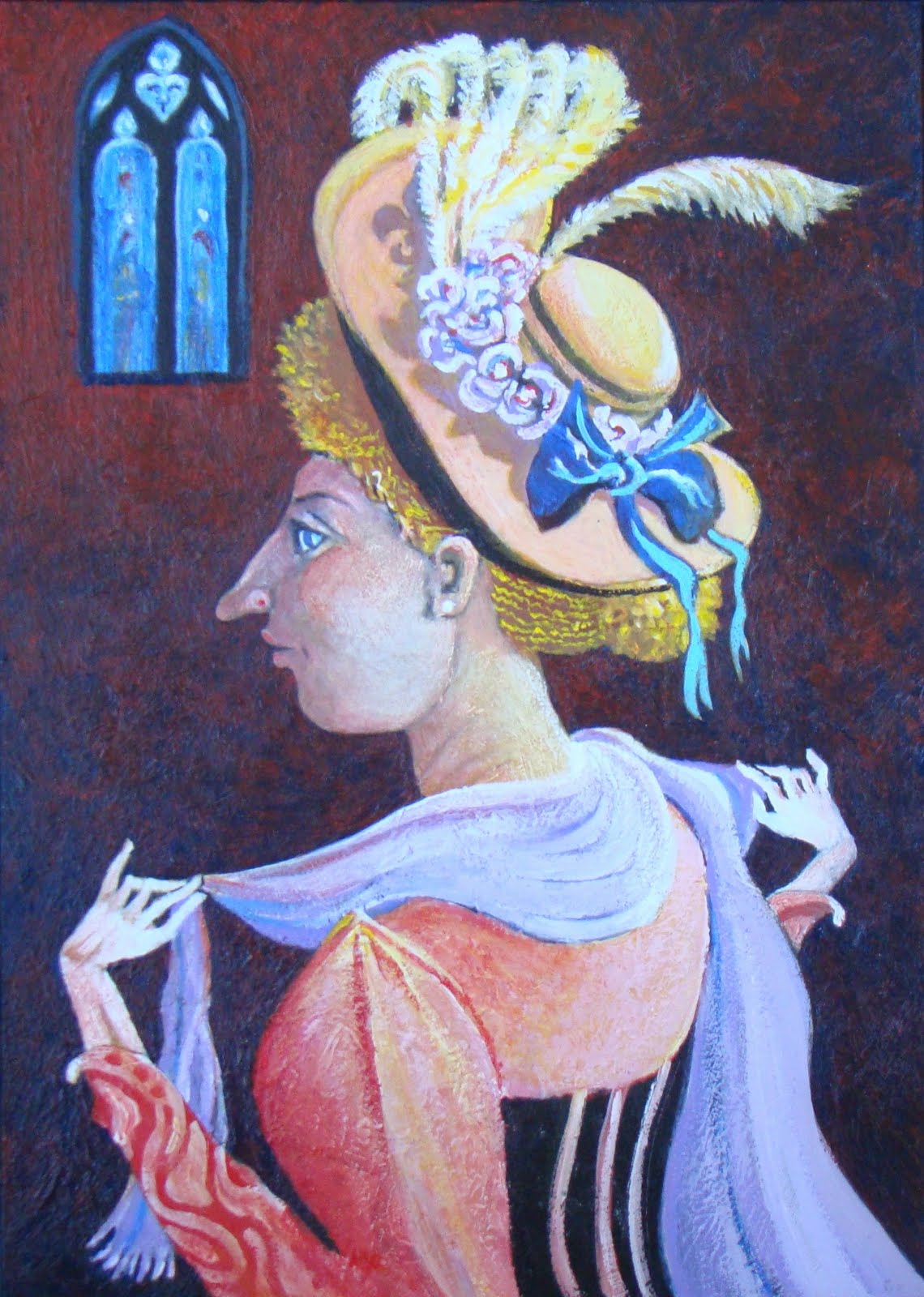
At the Opera...
At the matinée...

Each panel is acrylic on masonite, 5x7 inches.
Each image expands when clicked.
 
 
Here they are as a tryptych...

As well as James Everett I'm grateful to Patrick Alexander and Dr. William C. Carter for their contributions to my attempt with the subject.

Monday, April 25, 2011

Charlus as Lear

"But good heavans!" cried Jupien, "I was right not to want to go too far. Look! He's already managed to get into a conversation with the gardener's boy. I had better say good-bye to you, sir, I must not leave my invalid alone for a second, he's just really a big baby now."
~Time Regained, page 897.

But how can we go too far with Charlus, or say good-bye to Marcel's characters? I'd sit with the baron for awhile, let him flatter and ramble, keep his hand off my knee, replace his wilted boutonnière with  a fresh blossom and think, were I myself, of painting him again.

Friday, April 22, 2011

The Illustrated Proust

Update: It should be noted that "The Illustrated Proust" is in manuscript and not available for sale.

Patrick Alexander and I have put together a draft version of "The Illustrated Proust". It includes 16 illustrations painted over the last nine months. They will accompany Patrick's tweets of In Search of Lost Time in a final version. The draft can be seen here: The Illustrated Proust. It is listed in the links to the right.
Here are three scenes...
Marcel and the madeleine

Mlle Swann and the Duke and Duchess de Guermantes

Charlus hosting Mme Verdurin's soirée

Tuesday, August 24, 2010

Friday, June 25, 2010

Brichot avec lunettes and 5 more make 77

Brichot avec lunettes

Princesse Sherbatoff

Ski

The fisher girl at Carqueville

M. de Forcheville

Miss Sacripant

Tuesday, February 9, 2010

13 more characters from The Search

Names, no doubt, are whimsical draughtsmen, giving us of people as well as places sketches so unlike the reality that we often experience a kind of stupor when we have before our eyes, in the place of the imagined, the visible world (which, for that matter, is not the real world, our senses being little more endowed than our imagination with the art of portraiture - so little, indeed that the final and approximately lifelike pictures which we manage to obtain of reality are at least as different from the visible world as that was from the imagined).
~Within a Budding Grove, page 590.

Mme de Cambremer after a strenuous session of music,
her diamond earrings fallen, her headpiece of black grapes
come undone.

Mlle Vinteuil recalling a spell of very hot weather at Montjouvain.

Saniette waiting for thunder that never comes.

The affable Babal Bréauté.

Mme de Marsantes

Gísèle sur la plage à Balbec.

Rosemonde

Octave listening to La Voix Humaine.

Léa

Tomato Twin no. 1

M. Nissim Bernard, understanding resemblance is often only external.

Tomato Twin no. 2

Marie-Antoinette at her first soirée as
Charlus' inheritor, Mlle d'Oloron.

If, in the realm of painting, one portrait makes manifest certain truths concerning volume, light, movement, does that mean that it is necessarily inferior to another completely different portrait of the same person, in which a thousand details omitted in the first are minutely transcribed, from which one would conclude the model was ravishingly beautiful while from the first one would have thought him or her ugly, a fact which maybe of documentary, even of historical importance, but is not necessarily an artistic truth?
~Time Regained, pages 738-739.

Tuesday, January 6, 2009


Nadar's Marcel at 16.


A complete gallery of the characters from Marcel Proust's À la recherche du temps perdu would include more of the narrator’s family than his grandmother Berthilde, Mme Amèdée. Mamma, it goes without saying, would appear in a place of honor, and Father, and Aunt Léonie of the madeleines and the lime tisanes, and Uncle Adolphe with whom Marcel first meets Odette. François the family servant should join them of course; perhaps Eulalie. The walls would be crowded.

The actress Berma, the author Bergotte, the painter Elstir and the composer Vinteuil each deserve a portrait. Basin, Duc de Guermantes, and the Prince and Princess de Guermantes in their various incarnations must hang in the gallery. Monsieur Norpois and Mme de Villeparisis are necessary; the Princesses de Parme and Luxembourg; (or were they the same person?) perhaps not so much. Mme Verdurin needs M. Verdurin along with rest of the “little clan”: the Cottards, Brichot, Ski, Princess Sherbatoff and Saniette. The Bontemps and the Marsantes, the Cambremers and Mme de Saint–Euverte must round out society with the Arpajons, the Ambresacs and Gri-gri Agrigente. Forcheville must be there for Odette and Gilberte. Rachel the actress, Mme Stermaria, Andrée, of the “little band at Balbec”, and Bloch, Albert the nephew and even his uncle Saloman need a place. Jupien and Jupien’s niece (or is it his daughter?), and Charles Morel must surround and support the Baron de Charlus. And it would be pointless without portraits of the manager of the Grand Hotel, of the lift boy, and of Mme Putbus’s maid.

Except for Nadar’s photograph of Marcel and his mother, the 56 portraits here are of course imaginative. That they each share some resemblance is a measure of how much each is a facet of Marcel’s soul: In the end we must have faith in Marcel’s diligence and sincerity, (and sense of humor), as well as our own.
~4 July 2008


Oriane de Guermantes after winning a game of lawn tennis at la Raspelière.


Baron de Charlus returned to Paris, refreshed after a month at Balbec.


Charles Swann.


Odette de Crécy dressed as Oriane de Guermantes.


Gilberte Swann watching Marcel.


Albertine Simonet in her Fortuny gown.


Mme Verdurin somewhat amused by a non-sequiter.


Robert Saint-Loup the day before he fell in the trenches.


Grand-mère, Mme Amèdée watching Marcel as they listen to
the water-closet attendant on the Champs-Elysées.


~ The Hawthorns~


I found the whole path throbbing with the fragrance of hawthorn-blossom. The hedge resembled a series of chapels, whose walls were no longer visible under the mountains of flowers that were heaped upon their altars; while underneath, the sun cast a square of light upon the ground, as though it had shone in upon them through a window; the scent that swept out and over me from them was as rich, and as circumscribed in its range, as though I had been standing before the Lady-altar...

~Swann's Way, Combray, page 150.


Bergotte pleased to hear Marcel has read every word he's written.


Berma wearing her cowl in a performance of Racine’s Phèdre.


Vinteuil in retirement at Combray.


Elstir recalling his first drawing of Odette.


Françoise worried Marcel might marry Albertine.


Uncle Aldolphe.


Mme de Villeparisis resembling Drouais' Mme Pompadour at her tambor.


The marquis de Norpois.


Rachel recalling a comment about anti-Dreyfusard lesbianism.


Legrandin greeting Charlus at the Hôtel de Guermantes,
hoping Charlus does not recall their moment in the train station.


Aunt Léonie.


Théodore the grocer's boy taking Aunt Léonie's market order

with a swarm of angels around his head .


Albert Bloch about to recite Homeric verse in response
to a question on the weather.


Mme Bontemps worried that Marcel might not marry Albertine.


Jupien contemplating giving up his shirt maker's shop for the bordello.


Charles Morel no longer in need of his violin.


Basin de Guermantes eyeing carriage mares.


Andrée watching Marcel the last summer at Balbec.


~The Aeroplane~


...I had gone on horseback to call on the Verdurins and had taken an unfrequented path through the woods the beauty of which they had extolled to me. Hugging the contours of the cliff, it alternately climbed and then, hemmed in by dense woods on either side, dived into wild gorges. For a moment the barren rocks by which I was surrounded, and the sea that was visible through their jagged gaps, swam before my eyes like fragments of another universe: I had recognized the marine and mountainous landscape which Elstir had made of the scene of those two admirable watercolours, "Poet meeting a Muse" and "Young Man meeting a Centaur" which I had seen at the Duchesse de Guermantes's. The memory of them transported the place in which I now found myself so far outside the world of to-day that I should not have been surprised if, like the prehistoric age that Elstir painted, I had come upon a mythological personage in the course of my ride. Suddenly, my horse reared; he had heard a strange sound; then I raised my tear-filled eyes in the direction from which the sound seemed to come and saw, not two hundred feet above my head, against the sun, between two great wings of flashing metal which were bearing him aloft, a creature whose indistinct face appeared to me to resemble that of a man. I was as deeply moved as a Greek on seeing for the first time a demi-god. I wept - for I had been ready to weep the moment I realized that the sound came from above my head (aeroplanes were still rare in those days), at the thought that what I was going to see for the first time was an aeroplane. Then, just as when in a newspaper one senses that one is coming to a moving passage, the mere sight of the machine was enough to make me burst into tears. Meanwhile the airman seemed to be uncertain of his course; I felt that there lay open before him - before me, had not habit made me a prisoner - all the routes in space, in life itself; he flew on; let himself glide for a few moments over the sea, then quickly making up his mind, seemed to yield to some attraction that was the reverse of gravity, as though returning to his native element, with a slight adjustment of his golden wings he headed straight up into the sky.

~Cities of the Plain, Part Two: Chapter Three, page 1061-2.


Marquise, the water-closet attendant on the Champs-Elysées.


A chamber maid to Mme Swann.


Aimée, restauranteur par excellence.


Françoise's kitchen maid who Swann thought resembled

Giotto's figure of Charity in the intrado of the Cathedral at Padua.


~ The Martinville Steeples~


At a bend in the road I experienced, suddenly, that special pleasure which was unlike any other, on catching sight of the twin steeples of Martinville, bathed in the setting sun and constantly changing their position with the movement of the carriage and the windings of the road, and then of a third steeple, that of Vieuxvicq, which, although separated from them by a hill and a valley, and rising from rather higher ground in the distance, appeared nonetheless to be standing by their side.

In noticing and registering and the shape of their spires, their shifting lines, the sunny warmth of their surfaces, I felt that I was not penetrating to the core of my impression, that something more lay behind that mobility, that luminosity, something which they seemed at once to contain and to conceal.

~ Swann's Way, Combray, page 150.


Poullein, the footman denied his afternoon off and the chance to see his girlfriend by the Duchesse de Guermantes.


Mlle de Stermaria.


Doctor Cottard.


Brichot.


Mme de Saint-Euverte.


The boy who resembles the Angel on the Day of Atonement.


A chauffeur.


Mme Putbus' maid.


Mme de Saint-Euverte's pastry chef.


The footman recognizing the duc de Châtellerault on the reception hall steps.


The duc de Châtellerault telling the footman, "I don't speak French".


A parlour maid.


The lift boy at the Balbec Grand Hôtel.


~The Sea~


“… a band of red sky above the sea, compact and clear-cut as a layer of aspic over meat, then, a little later, over a sea already cold and steel-blue like a gray mullet, a sky of the same pink as the salmon that we should presently be ordering at Rivebelle, reawakened my pleasure in dressing to go out to dinner.”
~ Within A Budding Grove, Place-Names: The Place, page 861.


Swann's carriage driver.


The princesse de Parme.


Charlus' stable boy.


The milk-maid at the train station


~The matinée Guermantes: Four guests, wigged, with and without masks~


The former Prime-Minister.


Mme de Forcheville.


The prince de Guermantes.


Mme X


The former Prime-Minister, unmasked.


Mme de Forcheville, unmasked.


The prince de Guermantes, unmasked.


Mme X, unmasked.


The ruined Château de Guermantes.


Nadar's Jeanne Clémance Weil, Mme Proust.

~ ~ ~


My first reading of À la recherche du temps perdu, the Moncrieff-Kilmartin translation, began in the spring of 2006 and ended in the spring of 2008, (only to begin again).


The words at the beginning of this post, as well as the images seen here, were first posted to Nuukunui, a blog of my artwork and random notes. As some of the characters mentioned in those words have not been painted, and some not mentioned do, I expect the words to change. With the publication of Resemblances: The Portraits, Nuukunui can resume its own random trail.


The original portraits are acrylic on balsa, 3x4½ inches each, painted from 6 June to 16 November 2008.


I am grateful to my sister, Beth Richardson, who photographed the portraits with her Sony Cybershot H50 camera.


Two websites have been especially helpful: Mark Calkins' Temps Perdue.com , and the Google book on line, Who's Who in Proust by Patrick Alexander, (Xlibris, Booksurge, ISBN 978-1-4196-72507-7).


I am grateful to Rinaldo Alessandro Niccolo Notto for introducing me to the work of Wallace Fowlie, and for his unending encouragement to make art.


~DWR 7 January 2009